Terraces Above The Cloud
The walking here is optional in length, not in spirit: there is a short version and a long one, and the group splits without anyone feeling left behind.
What The Hills Eat
Mountain food here is warming rather than delicate. Thang co, a Hmong stew simmered all morning at market. Com lam, sticky rice cooked inside bamboo over a fire. Free-range black chicken, and salmon and sturgeon farmed in the cold streams above town, usually served as hotpot. Every village meal ends with corn wine, poured by the host and refused with some difficulty.
What Only Sapa Has
Fansipan, at 3,147 metres, is the highest point in Vietnam and the only summit of its kind you can reach without climbing. The cable car covers more than six kilometres and rises 1,410 vertical metres in about fifteen minutes, both Guinness records when it opened in 2016. Take the first departure: cloud closes the summit most days by late morning, and the queue does not.
Walking With The Villages
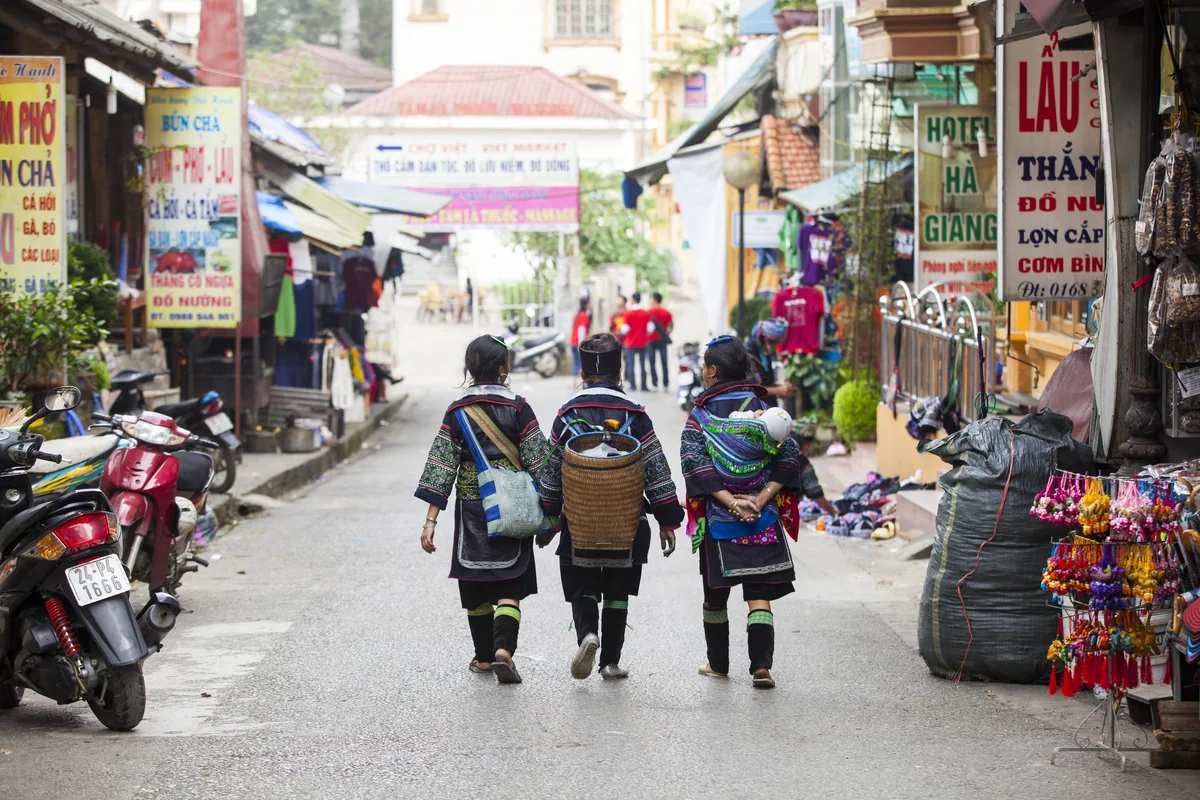
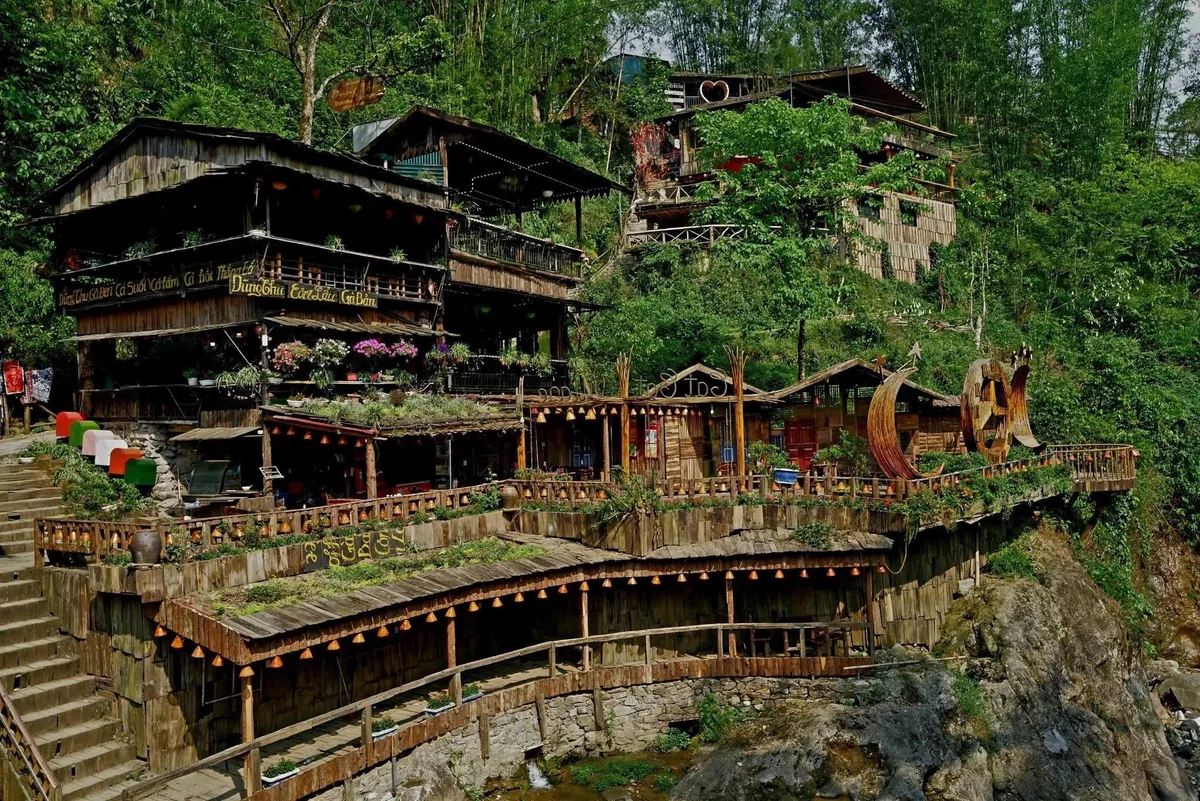
Trekking here means walking between homes, not through scenery. Hmong and Red Dao women guide sections of the valley themselves and will explain indigo dyeing, hemp retting and which terrace belongs to whom. Homestays at Ta Van and Ta Phin are ordinary houses with a spare room. Pay guides directly; the sales pressure of the town does not follow you onto the paths.
Top Highlights
- Walk down from the town into the Muong Hoa valley and follow the terrace edges through Lao Chai and Ta Van on foot.
- Take the first cable car of the morning to the Fansipan summit, before cloud closes over the highest point in Vietnam.
- Sleep a night in a Tay or Hmong homestay down in the valley, where dinner is cooked over a wood fire.
- Watch indigo dyeing and hemp weaving with Red Dao and Black Hmong women at Ta Phin, where it is still household work.
- Reach Bac Ha on a Sunday for the livestock market, three hours east, where Flower Hmong traders come down from the hills.
- Drive the Tram Ton pass behind Fansipan, the highest road pass in the country, where the weather changes on either side.
Region
Lao Cai province, north-west highlands
Airport
Noi Bai (HAN), then 5–6 hours by road
Best Months
September to November, and March to May
Suggested Stay
Two nights, three to walk properly
Known For
Rice terraces, hill villages, Fansipan
Pairs With
Hanoi, Bac Ha, Ha Giang
Sapa sits on a shelf at roughly 1,500 metres facing the Hoang Lien Son range, with Fansipan — 3,147 metres, after a resurvey in 2019 — a few kilometres to the south-west. The town has a few thousand permanent residents and many times that number of visitors on a spring weekend.
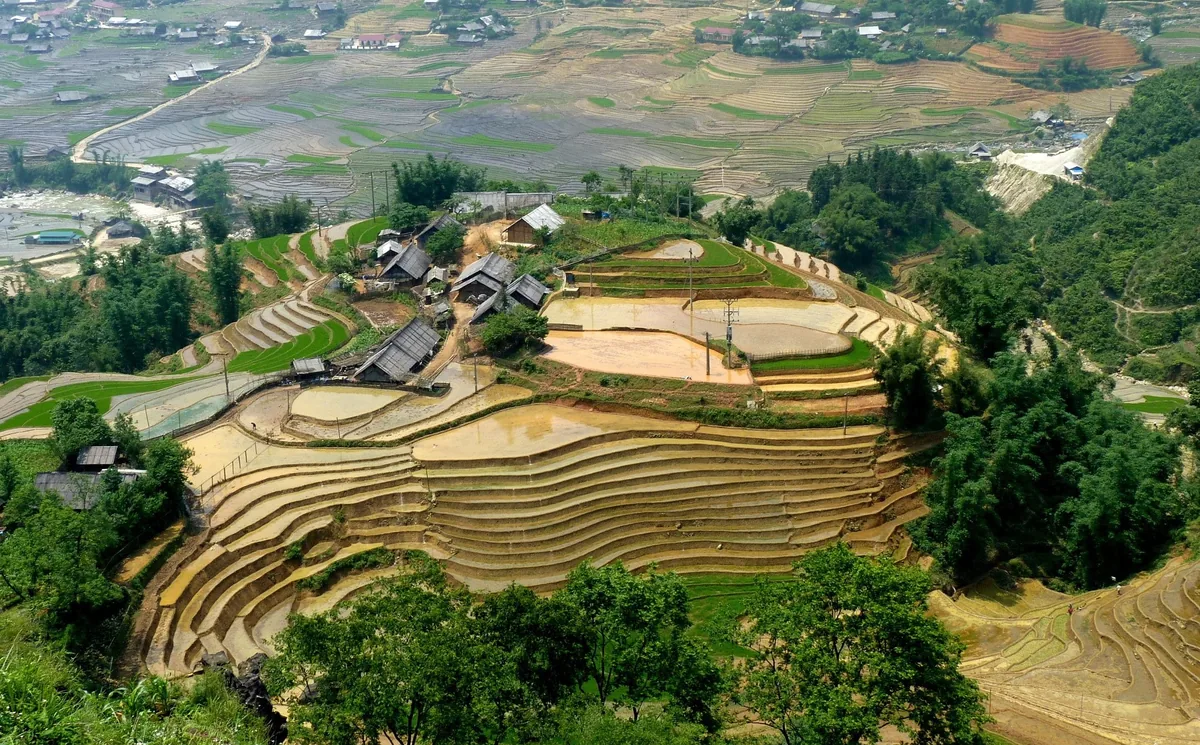
Most people in the surrounding countryside are not ethnic Vietnamese. Black Hmong are the largest group, then Red Dao, then Tay, Giay and Xa Pho, each with their own language, dress and farming calendar. The terraces are the shared work: fields cut level into slopes too steep for anything else, irrigated in sequence from the top of the hill down.
The town itself has been built up hard since the mid-2000s, with concrete hotels, a new square and permanent cranes. It is worth saying plainly. The valley is what survives intact, and it starts a fifteen-minute drive or a two-hour walk from the noise.
The French reached this valley in the 1880s and built a hill station here in the early 1900s — a sanatorium, villas, a stone church that still stands in the middle of town. Much of it was ruined in the fighting of the 1940s and again in the 1979 border war with China, fought a short distance north around Lao Cai.
Sapa reopened to foreign travellers in the early 1990s, when a walk to Ta Van was something you arranged yourself at the market. The railway to Lao Cai, laid by the French to reach Yunnan, carried nearly everyone until the Noi Bai–Lao Cai expressway opened in 2014 and roughly halved the journey from Hanoi. Visitor numbers multiplied within a few years, and the building followed.
Since July 2025 the province has been enlarged: Yen Bai was merged into Lao Cai, which now also contains the Mu Cang Chai terraces.
September and October are the harvest. The terraces turn gold, the air clears, and every photographer in Vietnam knows it. March to May is the other good window — planting, water standing on the fields and reflecting the sky, fruit trees in flower.
June to August is the wet season. Rain here is heavy and falls on steep ground; paths turn to slick clay and landslides can close roads for hours or days. It is also greener than at any other time.
December to February is cold. Single figures in town, below freezing at altitude, with occasional snow on Fansipan that draws a large domestic crowd, and fog that can sit in the valley for a week.
If the terraces are the point, come in September. If the walking is the point, come in October or April, when the ground is firm underfoot.
There is no airport. From Noi Bai the expressway runs about 245 kilometres to Lao Cai city, and a mountain road climbs the last 35 kilometres to Sapa: five and a half to six hours in total by private car or limousine van, the final ninety minutes on bends.
The overnight train is the alternative. It leaves Hanoi around ten at night, reaches Lao Cai near six in the morning, and still leaves an hour of transfer up the mountain. It saves a day and costs a night of proper sleep, and berths differ a great deal between carriage operators.
In Sapa the valley walks begin from the town itself, and a funicular runs out to the cable car station. Ta Phin, Bac Ha and the Tram Ton pass need a vehicle and a driver who knows how the fog behaves on that road.
Two quite different choices. In town you get a balcony over the valley, restaurants, and the noise of construction and late karaoke; the better addresses sit on the ridge above the centre rather than around the square.
Down in the valley — Ta Van, Lao Chai, Ban Ho — you get quiet, terraces outside the window and an early night. Options run from family homestays with shared bathrooms to a small number of well-built lodges. The trade-off is twenty to forty minutes of driving each time you want the town.
For small groups we usually split the stay: one night in the valley so the walking starts at the door, one nearer town when Fansipan or an early departure is on the plan. Heating matters between November and March, and not every property has it.
Bac Ha, three hours east, holds the largest market in the north-west on Sunday mornings: buffalo, horses, textiles, and Flower Hmong women in the most elaborate dress in the country. Can Cau, further north, runs on Saturdays and is smaller and much less visited.
The Tram Ton pass climbs behind Fansipan and drops into Lai Chau on the far side, with a reliable change of weather at the top. Beyond it the road runs west into country that sees very few foreign travellers.
South-east, Mu Cang Chai has terraces that many people rate above Sapa’s and a fraction of the traffic; it is a long day’s drive and now sits inside the same province. Ha Giang, east again, is the loop most travellers add when they have a week rather than three days.
Journeys through Vietnam
Departures that take in this part of Vietnam, plus the other places we cover there in depth.