Two Names, One City
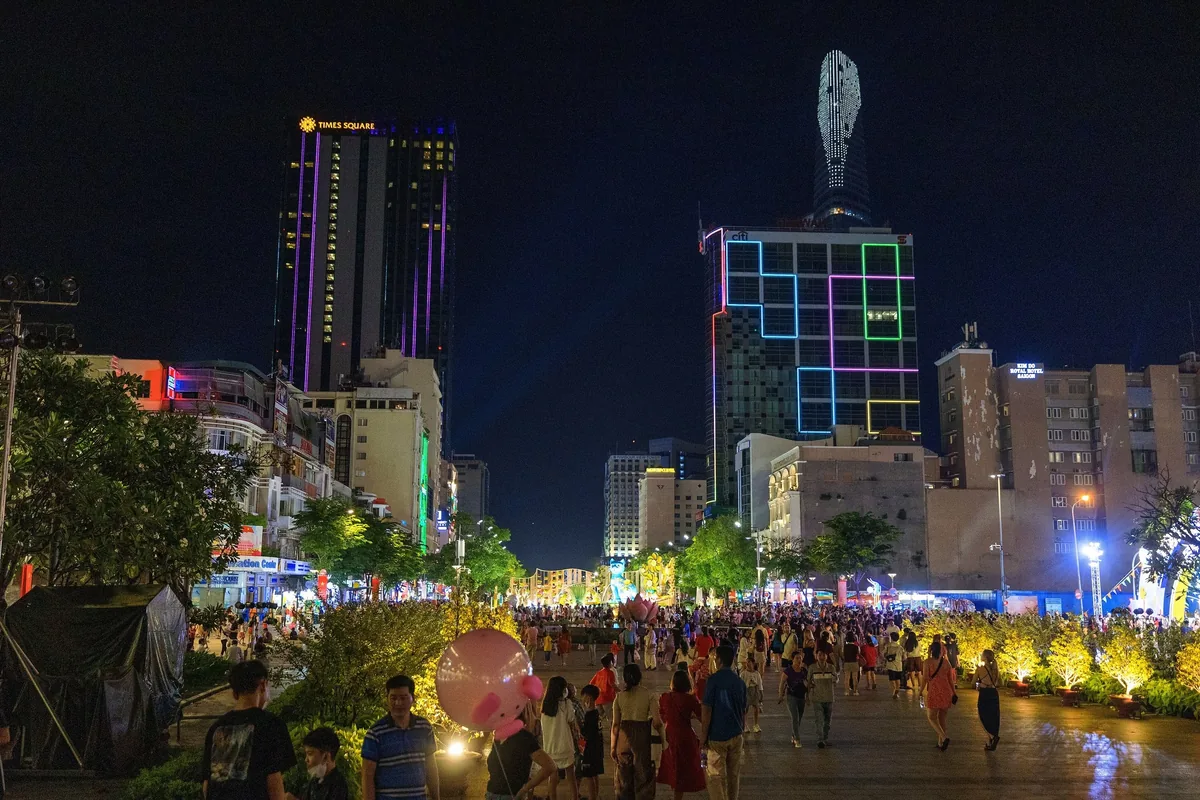
Saigon is a working city rather than a sight, and it suits the end of a journey — the group has learned enough by now for the museums and the alleys to land properly.
Coffee, Taken Seriously
Vietnam is the second largest coffee producer on earth and most of what it grows is robusta, which is why the local cup is dark, bitter and cut with condensed milk. Saigon drinks it iced, on a plastic stool, from six in the morning. New speciality cafés brew arabica from the highlands; the old shops still use a metal filter or a cloth sock. Both deserve an hour.
Eating On The Street
The city eats out. Southern cooking is sweeter and heavier on herbs than the north: broken rice with grilled pork for breakfast, banh mi from a cart, banh xeo folded around prawns and bean sprouts, and hu tieu noodle soup from the Chinese-Cambodian tradition. District 4 and the lanes off the main avenues are where to look. Point at what other people are having.
Cho Lon
The Chinese quarter west of the centre has been trading since the eighteenth century, when Chinese merchants displaced from elsewhere in the delta settled here. It is a district of wholesale streets, herbalists, temple courtyards thick with coiled incense, and the Binh Tay market. It is less polished than District 1 and considerably more interesting. Go in the morning, on foot, and accept getting lost.
Top Highlights
- Ride Metro Line 1 from Ben Thanh out towards Suoi Tien, the city’s first line, opened in December 2024 and busy from the start.
- Spend a slow morning at the War Remnants Museum, then walk ten minutes to the Independence Palace and the gates of 1975.
- Cross into Cho Lon for the Binh Tay market and Thien Hau temple, where the incense coils burn for weeks at a time.
- Drink ca phe sua da on a plastic stool at seven in the morning, before the heat arrives and the traffic thickens.
- Take a half day out to the Cu Chi tunnels, seventy kilometres north-west, going early to avoid both the crowds and the midday heat.
- Walk the streets of District 3 in the evening, where the trees, the older apartment blocks and the quiet make a different city.
Region
Southern Vietnam, Ho Chi Minh City
Airport
Tan Son Nhat (SGN), 8 km, 20 to 45 minutes
Best Months
December to March
Suggested Stay
Two to three nights
Known For
Street food, coffee, war history, Cho Lon
Pairs With
Mekong Delta, Con Dao, Phnom Penh
Saigon sits on a river of the same name, about sixty kilometres from the sea, on flat delta ground barely above sea level. That flatness matters: heavy rain and a high tide arriving together will put water across streets in the low-lying districts, and it has been getting worse rather than better.
District 1 holds most of what visitors come for — the old French core around the cathedral and post office, Ben Thanh market, the Independence Palace, the museums, the river walk. District 3 next door is quieter, with tree-lined streets and better cafés. Districts 5 and 6 are Cho Lon, the Chinese quarter. Across the river, Thu Duc is new-build towers and expatriate housing.
In July 2025 the city merged with Binh Duong and Ba Ria-Vung Tau provinces, which made it by far the largest administrative unit in the country, with around fourteen million people and a stretch of coastline. For a visitor almost nothing changed except the addresses on some paperwork.
The site was Khmer territory, a settlement called Prey Nokor, before Vietnamese migration south in the seventeenth century absorbed it. The French took it in 1859 and built Saigon as the capital of Cochinchina, laying out boulevards, a cathedral of imported brick, an opera house and a central post office whose ironwork is popularly credited to Gustave Eiffel, a claim historians dispute.
From 1955 it was the capital of the Republic of Vietnam. The war reached it directly during the Tet Offensive in 1968, and ended here on 30 April 1975 when North Vietnamese tanks came through the gates of the Independence Palace. The city was renamed shortly afterwards.
The years that followed were hard, with rationing, departures by boat and an economy that barely functioned, until the Doi Moi reforms of 1986 reopened private trade. Saigon moved fastest. Most of what you see now — the towers, the traffic, the money — has been built since the mid-1990s.
There are two seasons and no winter. The dry months run from December to April: warm days around thirty-two degrees, cooler mornings and very little rain. December to February is the pleasant end of it. March and April are the hottest, often into the high thirties with humidity to match.
The wet season runs May to November. It rarely rains all day. The pattern is a hard downpour in the afternoon, an hour of it, then clear skies and cooler air. It is a perfectly good time to visit provided you plan indoor things for four o’clock. September and October are the wettest, and street flooding is common in the low districts.
Two honest warnings. The city is hot in a way that tires people who are not used to it, and it is loud — traffic, karaoke, construction, from early until late. Ask for a room away from the street and treat the middle of the day as indoor time.
Tan Son Nhat is the country’s busiest airport, eight kilometres from the centre, which is twenty minutes at three in the morning and three-quarters of an hour in rush hour. A new terminal has eased the worst of the queuing. Long Thanh airport, about forty kilometres east in Dong Nai, is well advanced and targeted to begin commercial flights late in 2026; expect the changeover to take years rather than months.
Metro Line 1 opened in December 2024, running 19.7 kilometres from Ben Thanh to Suoi Tien with fourteen stations, the first three of them underground. Fares are a few thousand dong. It is clean, air-conditioned and useful for the eastern side of the city, though it does not yet reach most of what visitors want.
Otherwise it is ride-hailing apps, on four wheels or two, and they are cheap and everywhere. Crossing the road on foot does work: step off, walk at a steady pace, do not stop and do not run. The traffic flows around you.
Three places, and they ask for a settled frame of mind rather than a strong opinion.
The War Remnants Museum presents the war from the Vietnamese state’s perspective and does not pretend otherwise. The photography is the substance of it, including work by correspondents killed covering the conflict, and the rooms on Agent Orange and its effects are difficult. Give it two hours.
The Independence Palace is preserved as it stood in 1975: situation rooms in the basement, telephone banks, a helicopter on the roof, 1960s furniture upstairs. It reads less as a monument than as an office left in a hurry.
The Cu Chi tunnels are about seventy kilometres north-west. The network reached roughly 250 kilometres at its greatest extent, dug from the late 1940s onwards and used for living quarters, hospitals and supply routes. The sections open to visitors have been enlarged; the original passages were far smaller. There are two sites, Ben Dinh and the quieter Ben Duoc. Both have a firing range, which some visitors would rather skip.
District 1 is the default and the reasoning is simple: the museums, the market, the river and most of the restaurants sit within a twenty-minute walk of each other, and taxis to anywhere else are cheap. The trade-off is noise and price. Avoid the blocks immediately around Bui Vien unless you want a street that runs loud until three in the morning.
District 3 is five minutes away by car and a different city — shaded streets, older apartment buildings, good coffee, almost no coaches. For a second or third visit it is the better base.
Across the river, the Thao Dien area is green, low-rise and quiet, with pools and river frontage, but you will spend an hour a day in a car and cross a bridge that jams.
Wherever you book, ask for a high floor away from the road. The most common complaint about hotels in this city is not the room. It is what comes through the window.
Journeys through Vietnam
Departures that take in this part of Vietnam, plus the other places we cover there in depth.