Rowing With One Leg
We time the lake day against that rotating market when a departure allows it, because the market is where the lake stops performing and gets on with trading.
Floating Gardens
The tomato beds are the lake’s main crop and its oddest landscape: strips of matted weed and water hyacinth, built up over years and pinned to the lake bed with long bamboo poles, floating roughly a metre above the mud. Farmers work them from canoes, planting and picking at chest height. Rows run for hundreds of metres, and the crop goes north by truck.
Noodles And Tofu
Shan cooking is its own kitchen rather than a regional variant. The staple is a bowl of rice noodles with a thin tomato and chicken or pork sauce, eaten wet or dry with pickled greens on the side. Shan tofu is not soy at all but yellow split pea, set soft and warm, served as a salad or cut into strips and fried.
The Five-Day Market
The market does not stay in one place. It rotates on a five-day cycle between villages around the shore and up in the hills, and where it lands on a given day shapes much of the boat traffic that morning. Pa-O, Danu and Taung Yo traders come down from the surrounding hills to sell and to buy. Ask which village has it before fixing your day.
Top Highlights
- Watch Intha fishermen rowing standing, one leg wrapped around the oar, working a conical bamboo net over the reed beds at first light.
- Follow a side creek up to Indein, where several hundred stupas stand in every state between collapse and fresh restoration on a wooded hill.
- Build a morning around the rotating market, which lands in a different lakeside or hill village on each day of its five-day cycle.
- See lotus fibre drawn from cut stems and spun into thread at Inpawkhon, one of very few places anywhere that still weaves it.
- Visit Phaung Daw Oo, where five small Buddha images have lost their shape entirely beneath more than a century of applied gold leaf.
- Go out to the floating gardens in the early afternoon, when farmers are working the tomato rows from canoes tied to bamboo poles.
Region
Nyaung Shwe township, southern Shan State
Airport
Heho (HEH), about 1.5 hours by road
Best Months
November to February; cold at dawn
Suggested Stay
Three nights, two if time is short
Known For
Leg-rowing fishermen, floating gardens, Shan weaving
Pairs With
Bagan, Mandalay, Yangon
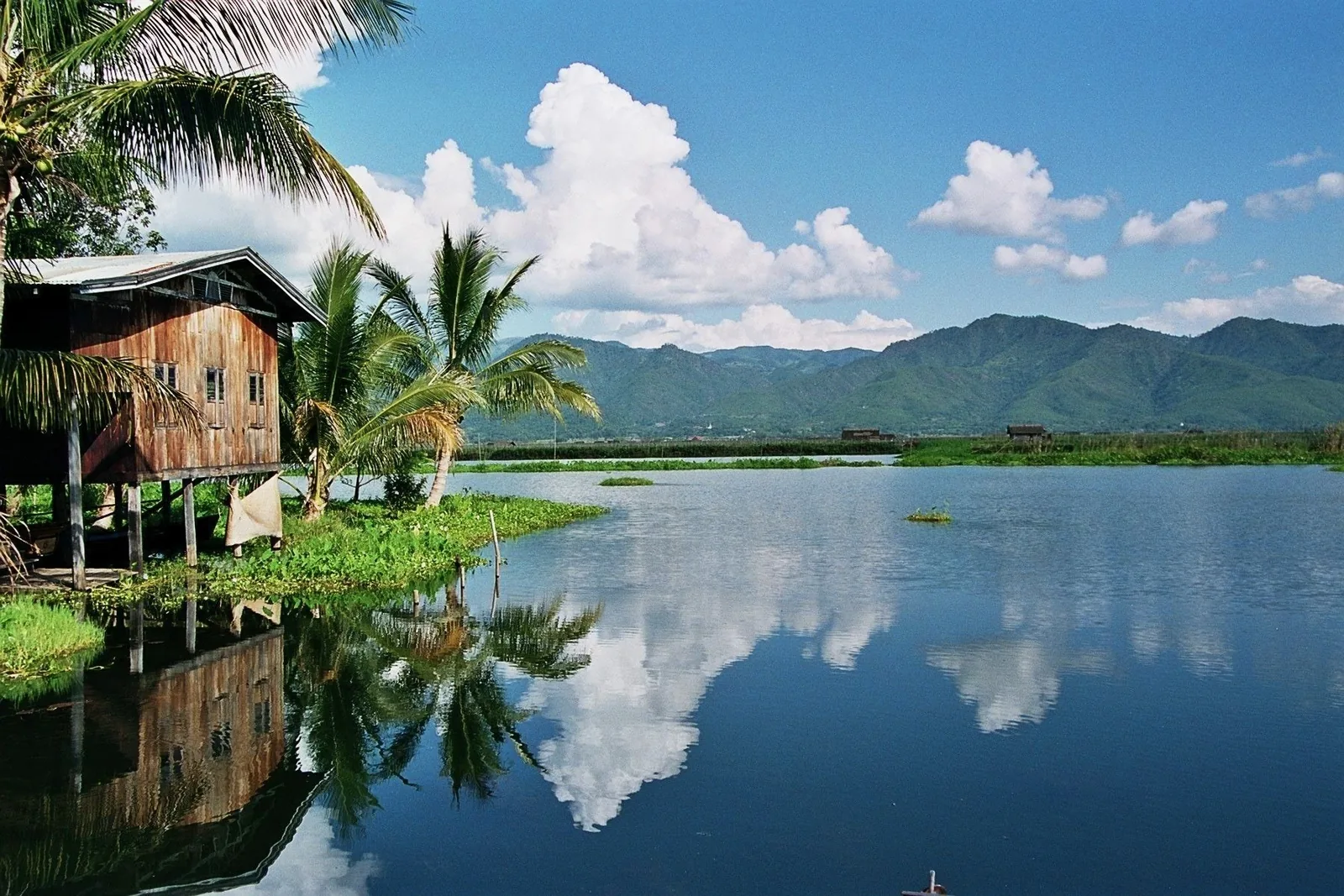
Inle lies at about eight hundred and eighty metres in a long valley in southern Shan State, roughly twenty-two kilometres north to south and eleven across at its widest. It is shallow — a couple of metres through the dry season, more in the rains — and much of the edge is reed bed rather than shoreline, so where the lake ends and the marsh begins is a question of the month.
Nyaung Shwe, at the northern end, is the town: guesthouses, restaurants, bicycle hire, the canal running down to open water, and the point where the zone fee is collected. Everything beyond it is reached by long boat under an outboard, which is loud and, before nine in the morning, cold enough to want a jacket.
Tens of thousands of people live on and around the water, most of them Intha, with Pa-O, Danu, Shan and Taung Yo communities in the hills behind. The villages stand on stilts and are connected by channels rather than streets.
The leg-rowing is practical, not performed. Standing on the stern with one leg curled round the oar gives a fisherman the height to see over the reeds and leaves both hands free for a conical bamboo trap, dropped over a fish and speared through the opening at the top. The men who row for cameras at the northern end are a separate trade; the working boats are further out and earlier.
The floating gardens are the lake economy. Weed and hyacinth are cut, matted, built up into long beds and pinned to the bottom with bamboo, and tomatoes are grown on them commercially in real quantity before being trucked north.
Workshops line the channels — lotus and silk weaving, silversmithing, boat building, cheroot rolling. Some exist for visitors and a few are genuine working shops. It is worth asking to be taken to the ones still weaving to order rather than by demonstration, and the difference is obvious once you are inside.
Inle is under real pressure, and it would be dishonest to describe it otherwise. The lake has been growing shallower for decades: deforestation in the surrounding hills sends silt down with every rainy season, and the shallower the water gets, the faster it warms and weeds over.
The floating gardens are part of the problem as well as part of the appeal. Commercial tomato growing on the beds uses fertiliser and pesticide that goes straight into the water, and the beds now cover a substantial share of what was open lake. Water hyacinth blocks channels. Hotel building directly over the water, much of it dating from the tourism boom of the 2010s, added to the load.
Conservation work has run for years with international support and some of it has helped. None of it has reversed the trend. Where you stay and where you eat matter more here than in most places, and we do not put people in rooms built out over the lake.
The earthquake of 28 March 2025 was centred far to the north-west, near Mandalay, but it reached this valley hard. Nyaungshwe township recorded well over a hundred deaths and several thousand damaged houses, and a number of the stilt villages and waterside buildings around the lake lost structures into the water.
Rebuilding on a lake is slow, because everything arrives by boat and depends on timber and piling. Some villages have been repaired, others still show gaps where a house stood, and several properties on the water have not reopened.
We set this out because it changes what a visit means at present. Nothing about the lake is closed to visitors, and the fishing, the gardens and the markets carry on much as they did, but you will see repair work and you will see damage, and it is more decent to arrive knowing that than to be surprised by it. We check accommodation and village access shortly before each departure.
November to February is the dry season and the best time here: clear skies, warm afternoons, and mornings that can drop close to single figures at this altitude. A boat at dawn in January is genuinely cold and very few people pack for it.
The rains run from late May into October. The lake fills, the hills turn green, and boat travel carries on as normal; the drawback is flat grey light and a wet middle to the day rather than any real obstacle. October, once the rain eases, is among the better months to come.
March to May is hot and hazy, and agricultural burning in the surrounding hills can hold smoke in the valley for weeks at a time, which takes out both the views and the air quality.
Inle sits in the pocket of southern Shan State that remains open to foreign visitors. Access to Kalaw, Pindaya and the walking routes between them has been variable, and we confirm it case by case.
Only a narrow part of Myanmar is open to foreign visitors at present. In practice that means Yangon, Bagan, Mandalay and this pocket of southern Shan State around Nyaung Shwe. Kachin, Rakhine, Chin, Kayah and Sagaing are subject to travel restrictions, as is most of Shan State beyond the lake, and we plan nothing in any of them.
A number of governments, the United States included, currently advise against travel to Myanmar or to parts of it. That is a decision to make on your own government’s wording rather than on ours. It also has a hard practical edge: most travel insurance is written to exclude countries carrying that kind of advice, so get your insurer’s position in writing before booking anything, flights included.
The tourist eVisa is applied for online — about USD 50, single entry, a maximum stay of 28 days, valid for 90 days from approval, usually issued within three to five working days. A zone fee for the Inle area is collected on arrival at Nyaung Shwe. Conditions move quickly here, and if anything material changes before departure we will tell you rather than let you find out on the ground.
Journeys through Myanmar
Departures that take in this part of Myanmar, plus the other places we cover there in depth.