A Plain Of Brick
Climbing the temples has been banned since 2019; the sunrise here is from a mound or a terrace, and any operator still promising a temple top is selling you a fine.
Inside The Temples
Most of what is worth seeing here is interior. Corridors run around a central brick core with seated Buddhas facing the four directions, lit only through pierced stone windows, and the walls carry paintings — Jataka scenes in small square panels, donor inscriptions, borders in red ochre and white. Bring a torch, and give the dark temples more time than the photogenic ones outside them.
Lacquerware Workshops
Bagan has made lacquerware for centuries and still does, in family workshops around Myinkaba and New Bagan. A bowl is built from woven bamboo, coated with sap from the thitsi tree, dried, polished and engraved, layer over layer, across several months. Good pieces flex when squeezed and return to shape. Ten minutes watching an engraver at work will change what you are willing to pay.
Early And Late
The plain is unpleasant between eleven and three: dry heat, almost no shade between monuments, and a flat white light that drains the brick of colour. The working pattern is a long first session from before sunrise to mid-morning, nothing until about four, then out again until dark. Plan the day around that rather than against it and Bagan becomes far more manageable.
Top Highlights
- Walk the corridors of the Ananda at opening time, when the four standing Buddhas are lit from above and the temple is close to empty.
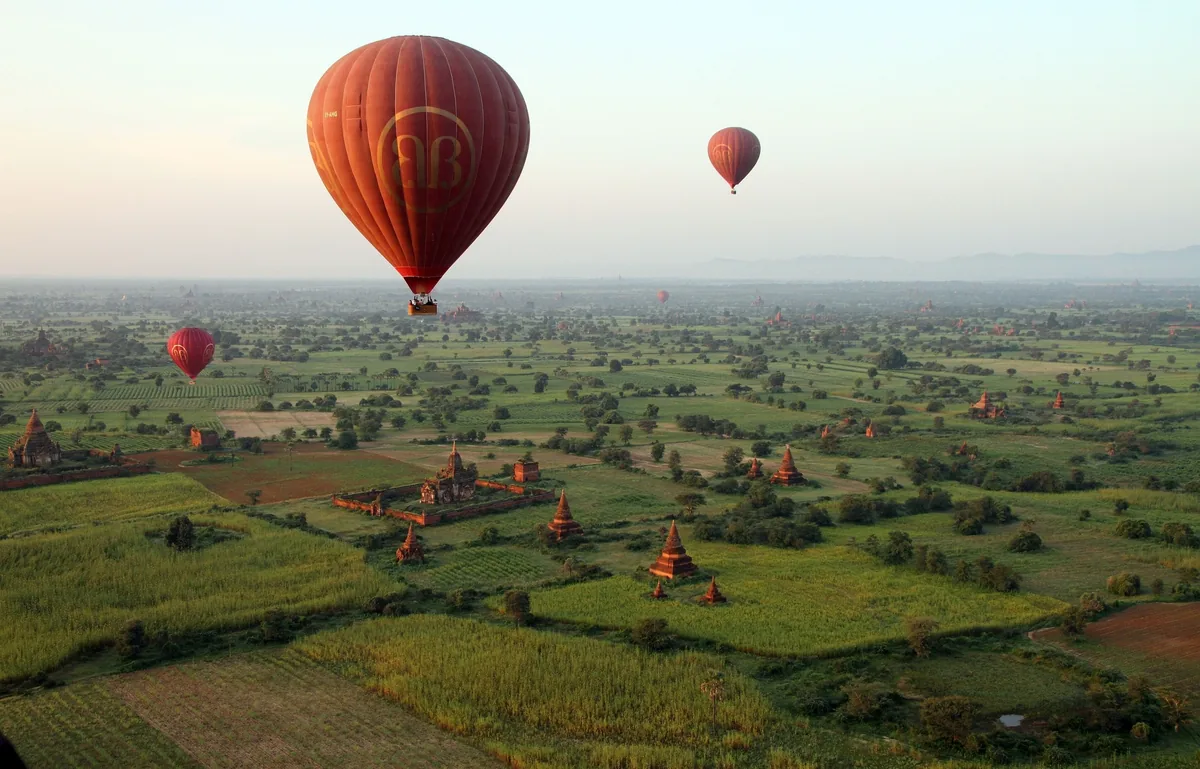
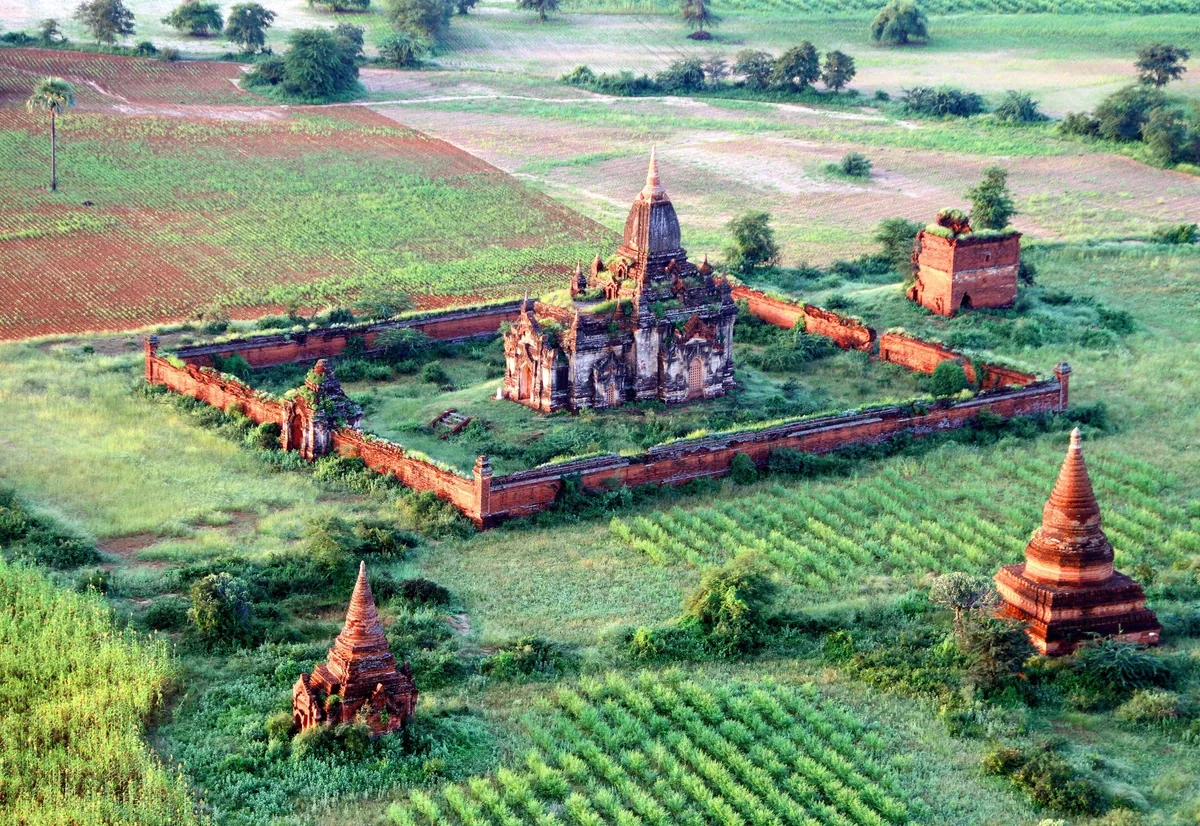
- Fly at dawn between October and early April, drifting for around an hour over brick spires with the river on one side and Mount Popa on the other.
- Take an e-bike along the sand tracks between Old Bagan and Myinkaba, stopping at whichever unlocked temple happens to look interesting.
- Find the wall paintings inside the Sulamani and the Gubyaukgyi, where painted panels and old inscriptions survive on surfaces nobody has restored flat.
- Watch sunset from a viewing mound or the river bank rather than a temple terrace, which has been off limits to climbers since 2018.
- Stand in a Myinkaba workshop while a bowl is engraved, one shallow line at a time, months after the first coat of lacquer went on.
Region
Mandalay Region, central dry zone
Airport
Nyaung U (NYU), flights from Yangon and Mandalay
Best Months
November to February; balloons October to early April
Suggested Stay
Three nights, two at an absolute minimum
Known For
Temple plain, wall paintings, lacquerware
Pairs With
Mandalay, Mount Popa, Yangon
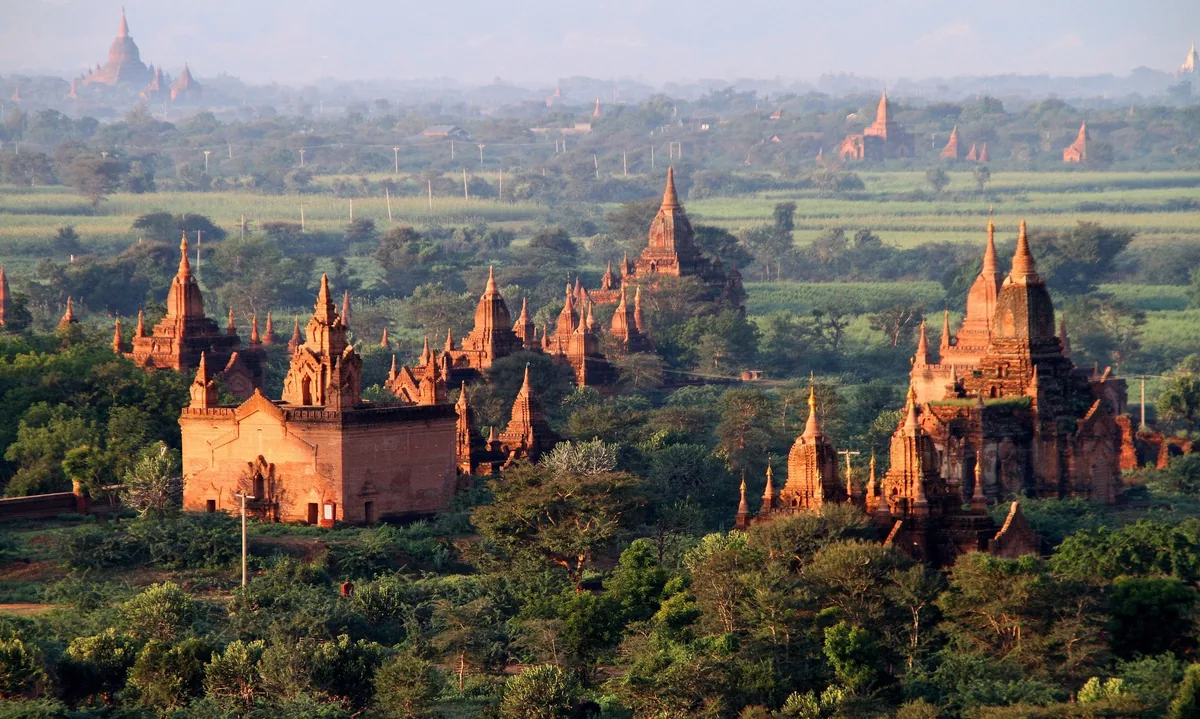
Bagan is not a town but a zone: three settlements and a scattering of monuments across a dry bend of the Ayeyarwady. Nyaung U in the north has the market, the airport and most of the cheaper accommodation. Old Bagan, inside the line of the twelfth-century walls, sits among the densest concentration of temples. New Bagan, to the south, was built in 1990 when several thousand residents were moved out of the old walled area — a displacement that is still part of how people here tell the story of the place.
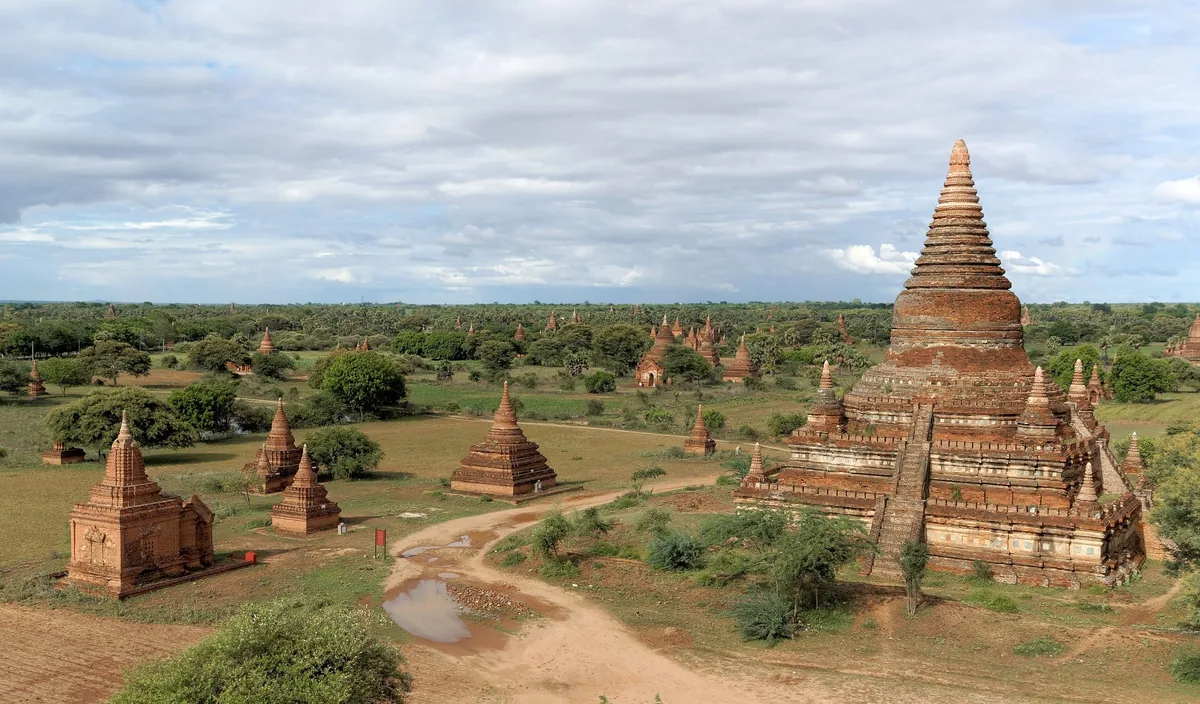
Between the three, the land is scrub, toddy palms, sesame and peanut fields, and brick. Monuments run from stupas the height of a person to temples of sixty metres and more, and a great many are unlabelled, unlocked and unattended.
An archaeological zone fee is payable on arrival, in kyat, and covers several days. The amount is revised from time to time, so we confirm it close to departure rather than print a figure that will date.
The building happened quickly. Between roughly 1044 and 1287 the kings of Pagan ruled most of what is now Myanmar from this stretch of river, and the merit-making economy of the period — a temple built improved the builder’s next life — produced something in the order of ten thousand structures in two and a half centuries.
The architecture changes visibly across that span. Early temples such as the eleventh-century Ananda are dark, thick-walled and inward-looking, lit through perforated stone windows. Later ones open out: taller, more window area, more brick and less mass, arriving eventually at the enormous Dhammayangyi and the Sulamani.
Inside many of them are wall paintings — Jataka scenes, donor inscriptions, geometric borders — some legible, some blackened by centuries of candle smoke, some heavily repainted during the reconstruction campaigns of the 1990s. Half of what is worth seeing in Bagan is on an interior wall in the dark, which is why guides here carry torches.
Bagan sits in an active seismic zone and its condition reflects that. A magnitude 6.8 earthquake on 24 August 2016 damaged several hundred monuments, bringing down spires and cracking vaults, and the repair programme that followed ran for years and drew in international conservation advice after criticism of the cruder rebuilding of earlier decades.
The far larger earthquake of 28 March 2025 — magnitude 7.7 on the Sagaing Fault, with its epicentre near Mandalay — caused further damage here, including to stupas around the Shwezigon, although the worst of that event fell on Mandalay and Sagaing rather than on Bagan.
The practical effect for a visitor is that some monuments are scaffolded and some interiors are shut, and which ones varies. UNESCO inscribed Bagan in 2019 for its merit-making tradition, its architecture and its living religious practice, and the property remains on the list. Come expecting a working conservation site rather than a finished one.
The balloons fly from October to early April, weather permitting, and not at all through the monsoon. Flights lift before dawn, last around forty-five minutes to an hour, and go wherever the morning wind takes them — there is no steering, so no two are the same and none can be promised. Services restarted in October 2024 after several years of suspension and a small number of operators now fly. Capacity is limited and the season sells out, so we book months ahead.
Climbing temples for sunrise ended in 2018: too many people on old brickwork, too many falls, and a fair objection to visitors standing on active religious buildings. Purpose-built viewing mounds went up instead — lower, less dramatic, considerably safer.
If you are not flying, the alternatives are those mounds, the terraces of one or two permitted structures, and the river bank at Old Bagan, which at sunset gives you the whole plain in silhouette from the west.
Nyaung U airport takes flights from Yangon and Mandalay, roughly an hour and a quarter and forty minutes respectively, on turboprops and small jets. Schedules are limited, departure times move, and we leave a buffer at both ends. By road, Mandalay is four to five hours; Yangon is a long day.
River boats between Mandalay and Bagan run downstream in about ten hours when they are operating, and cruise vessels work the same stretch in the high-water months. Sailings have been intermittent since 2021, so we confirm rather than assume them.
On the ground, electric bicycles are the standard way to move: quiet, cheap and quick enough to cross the plain in a morning. They are also the most common cause of injury to visitors here, because the tracks are deep sand and sand does not forgive a thin tyre. Horse carts are slower and better at dusk. A car with a driver makes sense for the longer runs between the three settlements.
The route through Myanmar is narrow at present, and while Bagan sits on it, most of the country does not. Foreign visitors are in practice limited to Yangon, Bagan, Mandalay and the Inle Lake area. Kachin, Rakhine, Chin, Kayah and Sagaing, along with most of Shan State outside Inle, are under travel restrictions, and we do not attempt them.
Several governments currently advise against travel to Myanmar in whole or in part, the United States among them. That advice is yours to read and yours to weigh. It also has a practical consequence: ask your insurer in writing whether the policy responds at all in a country carrying that rating. A good many do not, and a medical evacuation from the dry zone is not a thing to discover uninsured.
The tourist eVisa is applied for online — around USD 50, single entry, 28 days maximum stay, valid 90 days from approval, usually issued within three to five working days. Access to particular routes and sites can change at short notice, and we would rather move a plan than run one that has stopped making sense.
Journeys through Myanmar
Departures that take in this part of Myanmar, plus the other places we cover there in depth.