Between Two Rivers
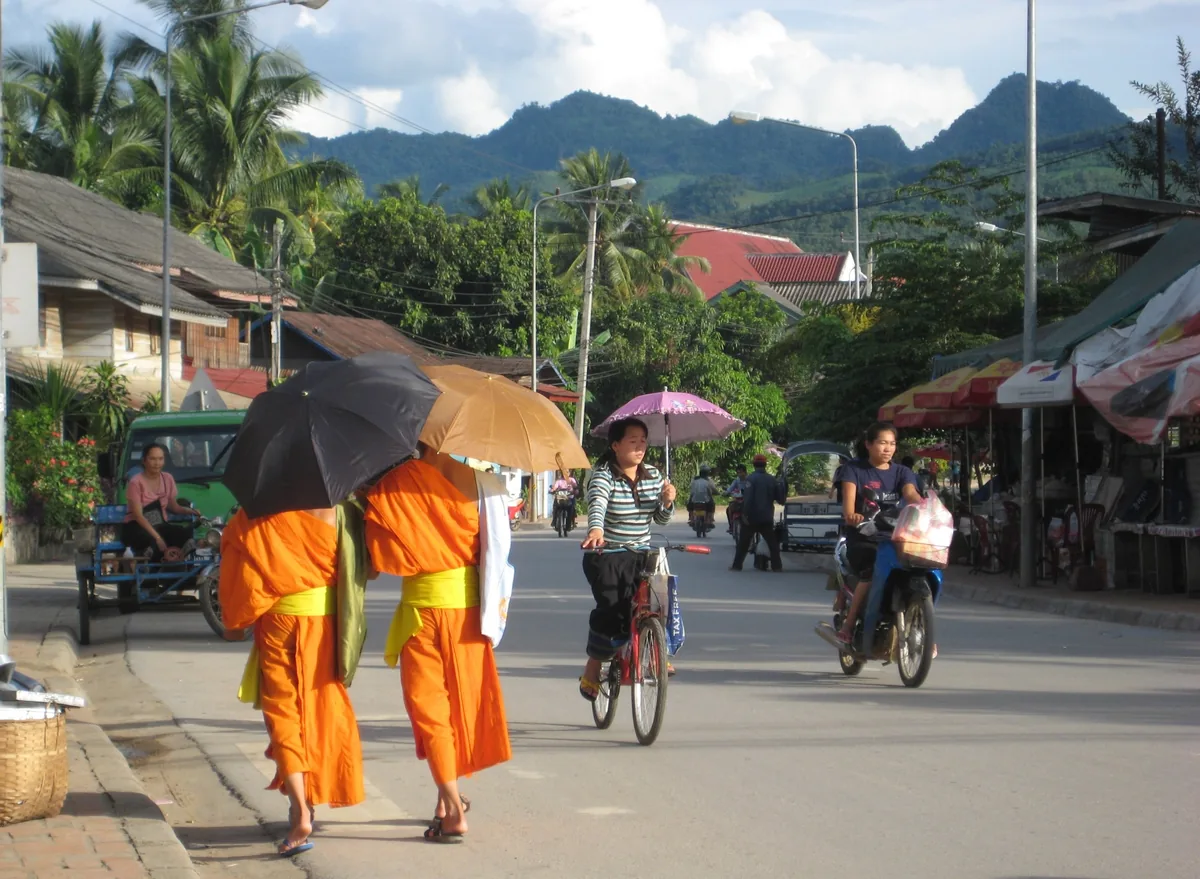
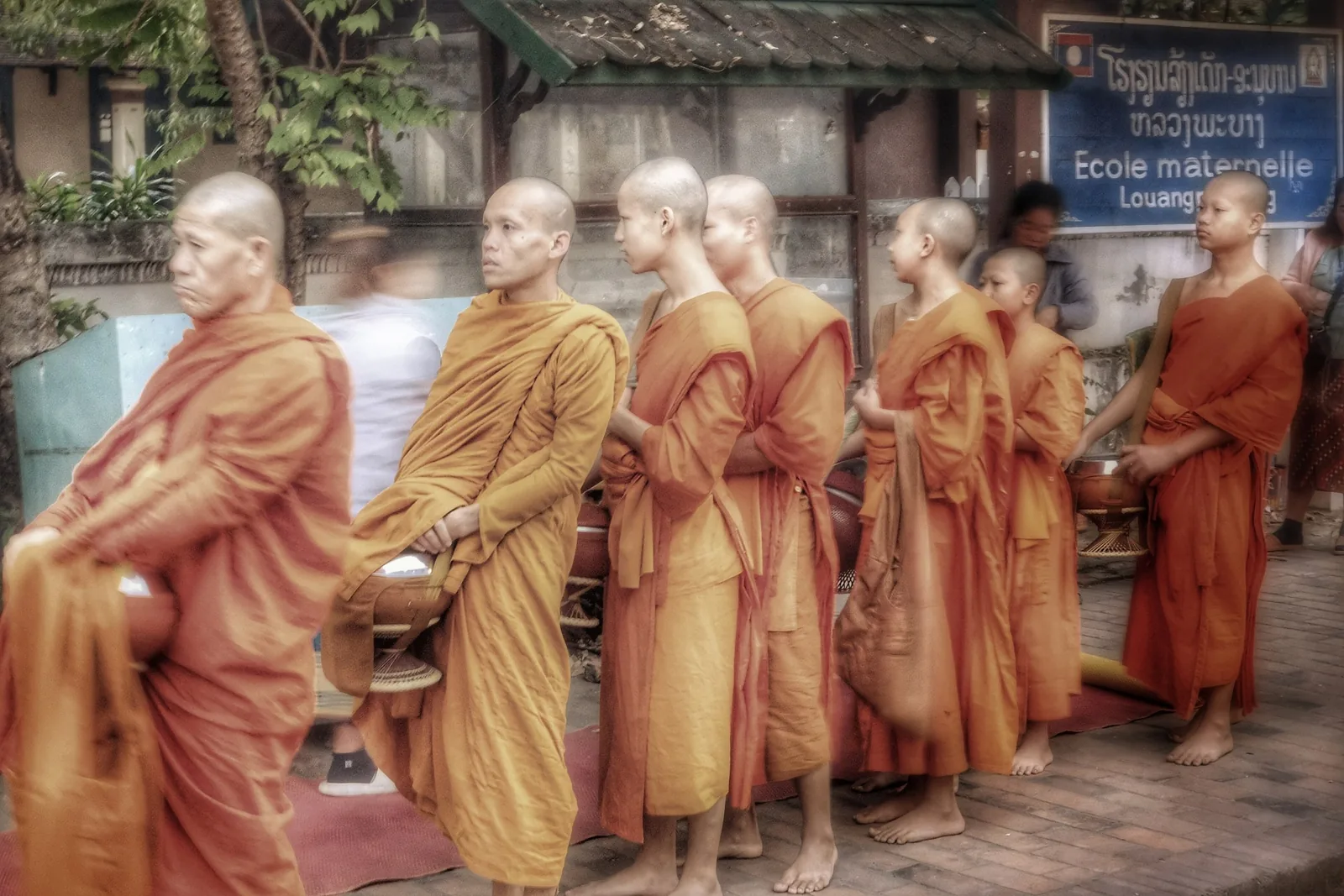
The alms-giving at dawn is the one thing we brief the group on properly before it happens — watched from a distance, in silence, without flash, or not watched at all.
What Luang Prabang Eats
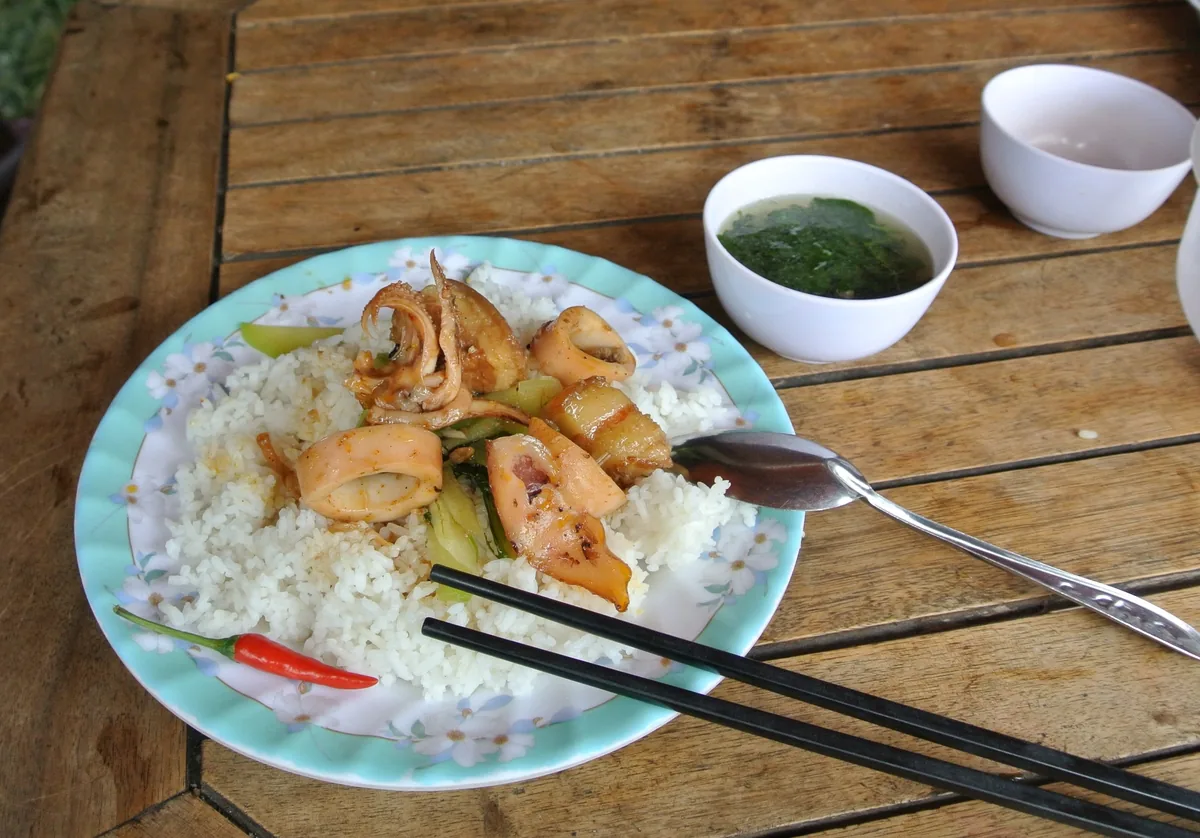
Breakfast is often khao soi — here a rice-noodle soup under a spoonful of fermented soybean and pork, nothing like the Chiang Mai dish of the same name. Look for jeow bong, a sweet chilli paste made with buffalo skin, and kaipen, river weed dried in sheets, pressed with sesame and fried. The morning market off Sisavangvong sells all three before eight.
Things Only Here
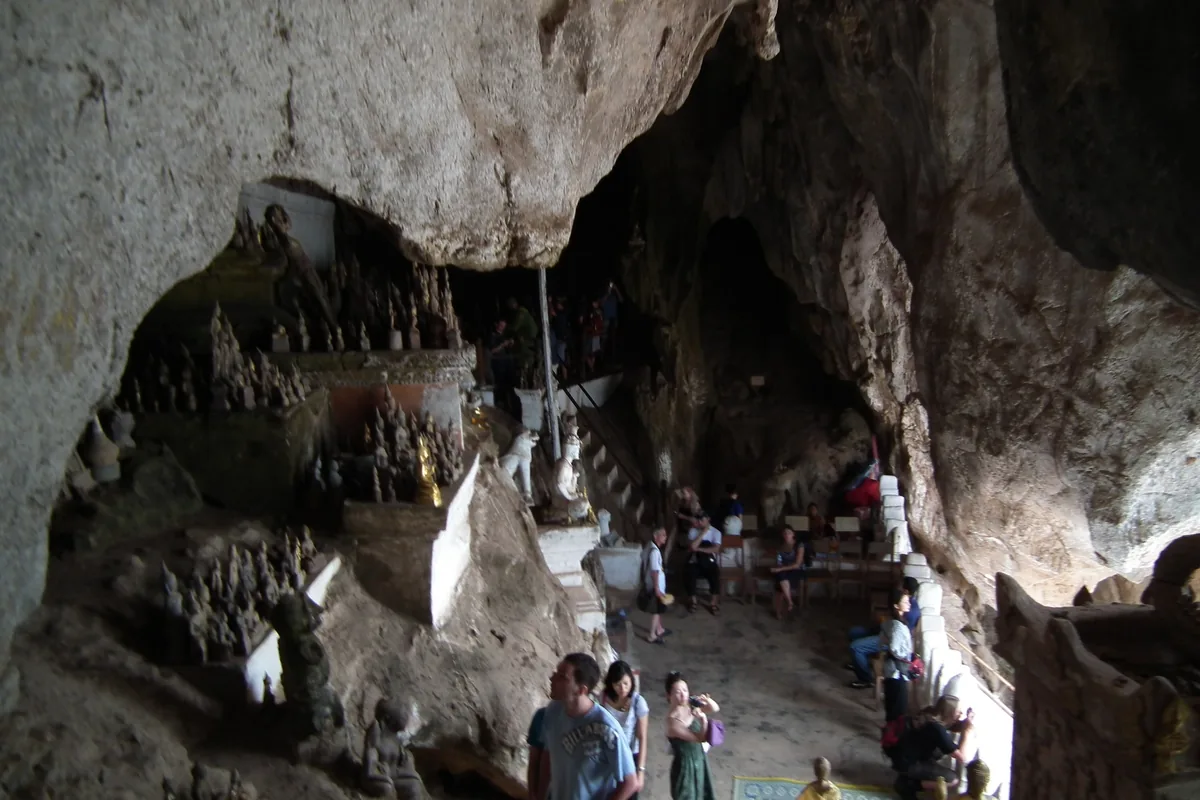
Wat Xieng Thong, finished in 1560, carries a tree of life in coloured glass across its rear wall — the sort of mosaic that only reads properly in late light. Twenty-five kilometres upriver, the Pak Ou caves hold several thousand Buddha images left by pilgrims over four centuries, stacked in two chambers in the cliff above the Mekong.
Meeting People Here
Weaving is a living trade here rather than a demonstration: an afternoon at a riverside workshop with a Tai Lue weaver will show you why a single skirt border takes weeks. Villages across the water make rice whisky and mulberry paper. Our guides grew up in these valleys, and the visit is arranged as a call on someone they know.
Top Highlights
- Climb the three hundred-odd steps up Mount Phousi before sunset for the full sweep of the peninsula, both rivers and the hills behind.
- Stand in Wat Xieng Thong at the end of the day, when low sun lifts the glass mosaic on the sim’s back wall.
- Walk the Royal Palace Museum, built for King Sisavang Vong in 1904 and left much as the family had it in 1975.
- Swim in the limestone pools below Kuang Si, thirty kilometres south, and look in on the rescued moon bears beside the path.
- Take a longboat two hours upstream to the Pak Ou caves, stopping at the whisky village where the jars are still buried.
- Watch the morning alms round from a distance, seated and silent, or skip it entirely and go to the fresh market instead.
Region
Northern Laos, Mekong–Nam Khan confluence
Airport
Luang Prabang (LPQ), 4 km, 15 minutes
Best Months
November to February; avoid March and April
Suggested Stay
Three nights, four with Kuang Si and Pak Ou
Known For
UNESCO old town, alms round, Kuang Si
Pairs With
Nong Khiaw, Vientiane, Chiang Mai
The old town occupies a peninsula about a kilometre long, bounded by the Mekong on one side and the Nam Khan on the other, with a single wooded hill — Phousi — in the middle. Nothing is far from anything. Something like thirty-three monasteries are still in use, and the novices you see at dawn are boys sent down from villages for the schooling.
UNESCO listed the town in 1995 for the way Lao religious architecture and French colonial building sit together in one street, and the listing has kept heights down and signage restrained. It has also made the centre expensive, and a good deal of it now runs on guesthouses and cafes. Walk five minutes past Phousi in any direction and you are back in an ordinary Lao town of workshops, schools and noodle stalls.
Luang Prabang was the seat of Lan Xang, the kingdom of a million elephants, founded in the fourteenth century. It takes its name from the Phra Bang, a gold Buddha image sent from the Khmer court and still kept here. The kingdom split into three in the eighteenth century; Luang Prabang survived as a smaller royal capital, paying tribute in several directions, and the French, arriving in the 1890s, left the monarchy in place under a protectorate.
That arrangement produced the town you see: shophouses with shuttered upper floors, built by Vietnamese masons the French brought in, set among monasteries several centuries older. Very little was cleared to make room.
The monarchy ended in 1975, when the last king was removed by the Pathet Lao and died in a camp in the north. The palace became a museum. The Phra Bang stayed.
November to February is the reliable window: dry, clear, cool at dawn and warm by midday, with the rivers still high enough for boat trips. December and January are the busiest weeks of the year and the town feels it.
March and April are the problem months. Farmers across northern Laos and the provinces around it burn fields before the rains, and Luang Prabang, sitting in a river valley, holds the smoke. Air quality in those weeks has repeatedly been among the worst measured anywhere, and the view from Phousi disappears entirely. If your dates are fixed to March, come knowing this.
The rains run May to September — heavy, brief and mostly in the afternoon. The countryside is green, the waterfalls are full and brown, and rooms are cheaper. Pi Mai, Lao new year, falls in mid-April and closes the town for several days of water throwing.
Luang Prabang International sits four kilometres from the centre, with direct flights from Bangkok, Chiang Mai, Hanoi, Siem Reap, Kunming and Vientiane. It is a small airport and a delay slows down the whole day.
The Laos–China railway, open since December 2021, has changed how most people arrive. Vientiane to Luang Prabang takes under two hours on the fast service and around three on the slower one — a journey that used to be a long day’s drive over mountains. The catch is the stations: Luang Prabang’s is a dozen kilometres out of town, Vientiane’s about sixteen, and seats are released only a few days ahead and sell out the morning they open. We book them for you.
The two-day slow boat from Huay Xai on the Thai border still runs, with a night at Pak Beng. In town, everything worth seeing is walkable.
The peninsula itself — the streets between Phousi and Wat Xieng Thong — puts you inside the old town, minutes from the monasteries and the night market, in converted shophouses and small colonial villas. Rooms are modest by regional standards; the buildings are protected, so lifts and large bathrooms are rare.
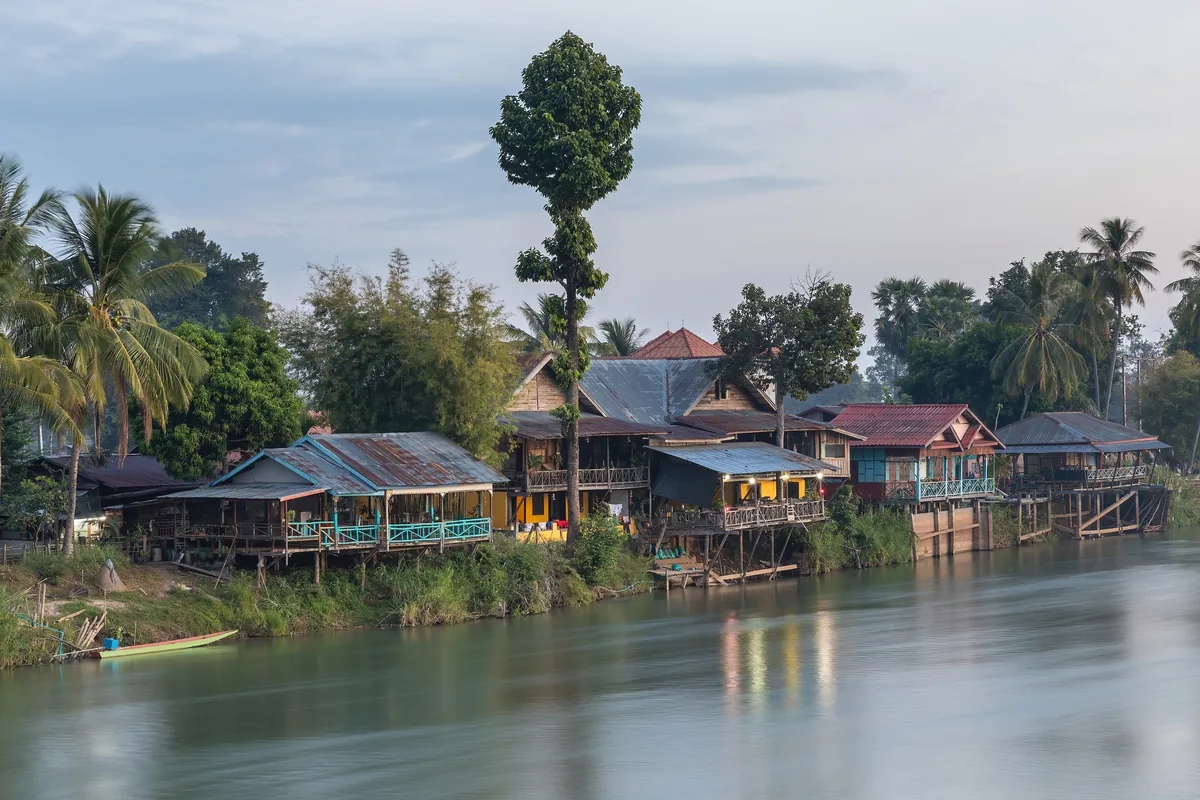
The Nam Khan bank is quieter, with gardens and river views, and is still an easy walk in. Across the Mekong, and out along the airport road, are the larger resorts with pools and space for families, at the cost of a shuttle every time you want dinner.
We would rather put you on the peninsula for the mornings. The town is at its best before seven, and if you are staying twenty minutes away you will not see it.
Kuang Si is thirty kilometres south, about forty-five minutes on a decent road: turquoise limestone pools stepped below a main fall, with a bear rescue centre on the walk in that holds Asiatic black bears taken out of the bile trade. Go before ten or after three; the tour vans fill the middle of the day.
Pak Ou, upstream where the Nam Ou joins the Mekong, is roughly two hours by longboat each way and holds thousands of Buddha images in two cliff caves. The boat is as much the point as the caves.
Further out, Nong Khiaw is three and a half to four hours north by road, into karst country on the Nam Ou, and is the natural second stop for anyone who wants mountains rather than temples.
Journeys through Laos
Departures that take in this part of Laos, plus the other places we cover there in depth.